

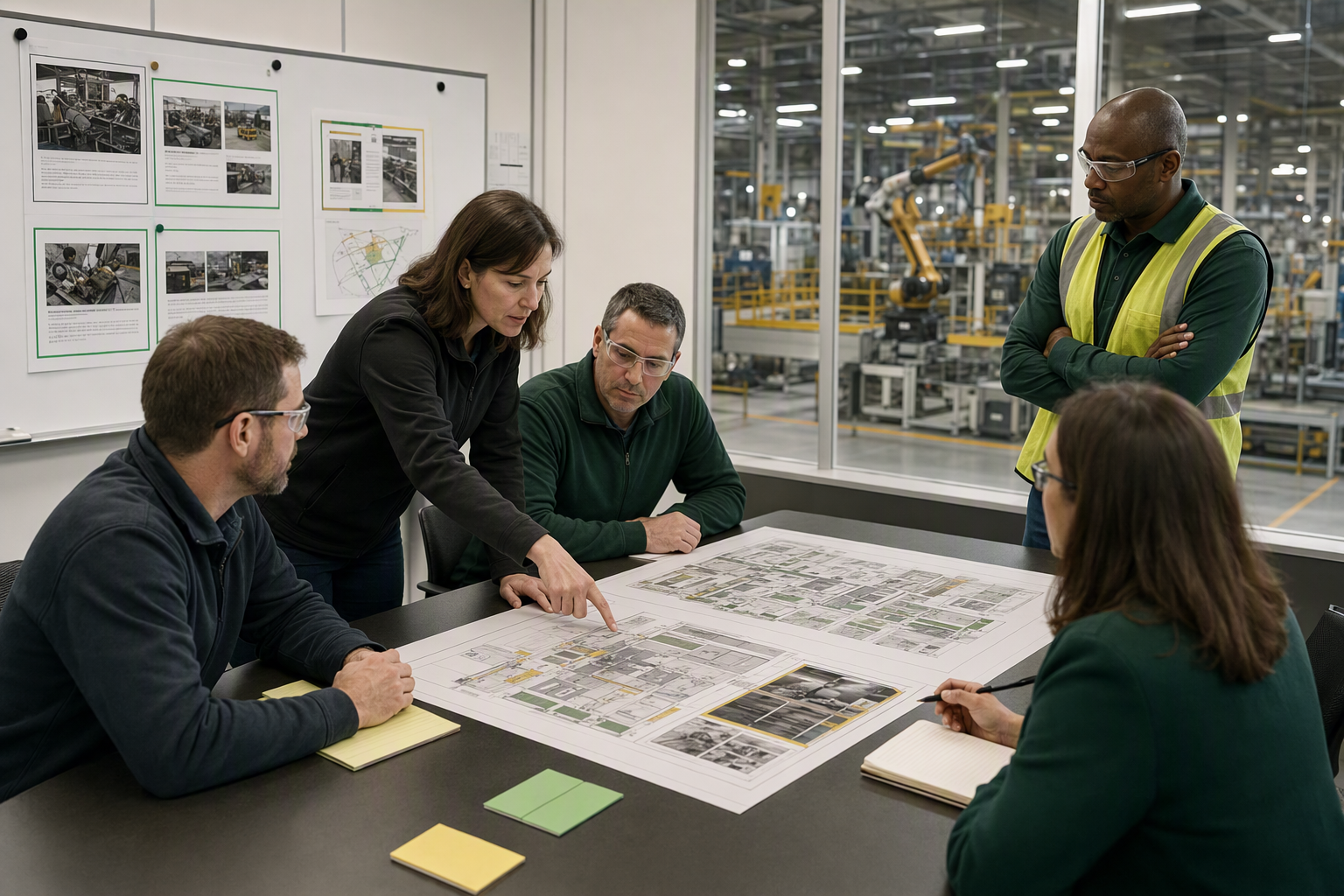
Manufacturers scale AI visual inspection by standardizing the inspection lifecycle, governance, interfaces, and evidence requirements. They reuse validated deployment patterns where production conditions match, then adapt and revalidate each implementation for the local product, process, camera, optics, lighting, line response, and operational risk.
Why is model replication not the same as scale?
A model that performs well on one line learned from that line’s images and operating conditions. Another facility may run a different SKU mix, supplier lot, surface finish, fixture, camera angle, or illumination. Moving the model without checking those differences can create a silent performance gap.
What should travel first is the deployment pattern: the problem definition, image requirements, labeling logic, acceptance criteria, validation protocol, controls interface, monitoring plan, and version history.
What should be standardized and what stays local?
| Standardize across the enterprise | Confirm at each production line |
|---|---|
| Use-case intake and prioritization | Defect definition and business consequence |
| Approved hardware and integration patterns | Optics, lighting, position, and image quality |
| Labeling, versioning, and access controls | Representative products, shifts, and process variation |
| Validation evidence and release workflow | Thresholds, false accepts, and false rejects |
| Monitoring and escalation standards | Ownership, response, and retraining triggers |
What is a practical five-stage rollout model?
- Prove the complete operating workflow. Select a valuable, feasible first use case and validate the path from image capture to production response.
- Package the reusable deployment pattern. Document the imaging setup, label definitions, model version, interfaces, acceptance tests, and operating ownership.
- Replicate on a comparable line. Choose a line with sufficiently similar conditions, gather local images, measure the gap, adapt where needed, and revalidate.
- Build a governed use-case portfolio. Prioritize opportunities by value, feasibility, repeatability, and operational readiness rather than by whoever asks first.
- Expand through trained plant teams. Give authorized teams the workflow and guardrails to deploy, monitor, and improve inspections without uncontrolled model sprawl.
What belongs in a reusable deployment package?
- Business problem, defect taxonomy, and product scope
- Reference images and minimum image-quality requirements
- Supported camera, lens, lighting, compute, and interface pattern
- Training-data lineage, label guidance, and model version
- Acceptance thresholds and a representative validation set
- Configured line response and evidence-retention behavior
- Named owner, escalation path, and retraining triggers
This package reduces reinvention while making local differences visible before a production release.
How can governance scale without becoming the bottleneck?
A central team should define standards, approve platform patterns, maintain shared assets, and support unusual cases. Plant teams should own local data collection, process decisions, validation participation, and routine adaptation inside those guardrails.
If every adjustment requires the central AI team, the backlog simply changes owners. If every plant operates independently, the enterprise loses reuse and control. The scalable model is federated: central enablement with accountable local ownership.
How should manufacturers measure visual inspection scale?
Count deployed and sustained use cases, but also measure the system that produces them:
- Median time from approved use case to production deployment
- Effort required for the second and subsequent lines
- Percentage of deployments using approved reusable patterns
- Performance stability and retraining frequency after release
- Quality, scrap, throughput, labor, and safety outcomes defined for each use case
How United Vision supports factory and multi-site scale
United Vision gives plant teams a full-lifecycle workflow to capture, define, train, deploy, and adapt visual inspections. Its factory-level model—One factory. One price. Unlimited use cases.—is designed to make expansion across lines economically predictable while preserving plant ownership. Each environment still requires appropriate imaging, integration, and validation.
The goal is a learning system
Each deployment should make the next one faster because the organization retains the pattern, evidence, and operating knowledge. That is how manufacturers turn isolated pilots into a sustainable visual inspection capability across lines and facilities.
Plan the path from one line to factory-wide scale
United Vision can help your team qualify the first inspection, define the reusable operating pattern, and determine what must be validated locally as deployment expands.
Discuss a rollout modelContinue the series
Compare one-off projects with a factory-wide platform, or build the process for keeping production inspection models current.